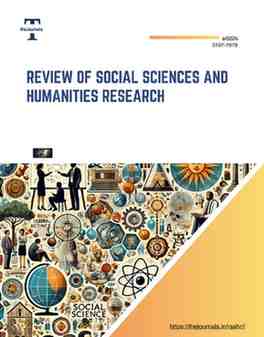
About :
Review of Social Sciences and Humanities Research is a bi-annual, peer-reviewed, national e-journal dedicated to advancing research across a diverse range of social sciences, arts, humanities, and interdisciplinary fields. It provides a platform for scholars, educators, policymakers, and practitione
Read more
About Journal
Review of Social Sciences and Humanities Research is a bi-annual, peer-reviewed, national e-journal dedicated to advancing research across a diverse range of social sciences, arts, humanities, and interdisciplinary fields. It provides a platform for scholars, educators, policymakers, and practitioners to share original research and critical insights across the realms of society, culture, politics, and human studies.
139-D, Pocket-6, MIG Flats, Mayur Vihar-3, Delhi-110096, India
Aim
Review of Social Sciences and Humanities Research is an interdisciplinary journal dedicated to advancing scholarship across the social sciences, arts, and humanities. The journal aims to foster rigorous and innovative scholarship across the humanities and social sciences, providing a platform for interdisciplinary dialogue and critical inquiry. It seeks to publish original research that advances understanding of cultural practices, historical processes, demographic change, language and media, and philosophical and ethical perspectives. By encouraging diverse methodologies and comparative approaches, the journal promotes work that bridges theory and practice, informs policy, and contributes to social transformation. Its mission is to highlight voices from varied contexts and support research that addresses equity, sustainability, and global interconnectedness.
Scope
Anthropology and Cultural Studies This category anchors the journal in the deep traditions of the humanities and social sciences. It welcomes research on human societies, cultural practices, identity formation, and symbolic systems. Contributions may include ethnographic studies, comparative cultural analyses, and explorations of contemporary cultural narratives. The journal particularly values work that interrogates diversity, indigenous knowledge, and the intersections of culture with globalization.
Demography and Human Development Work in demography and human development provides quantitative and developmental perspectives. It covers demographic trends, migration, fertility, mortality, and social change, as well as longitudinal studies of human development across the life span. The journal encourages interdisciplinary approaches that combine statistical analysis with sociological, psychological, and cultural insights to understand population dynamics and developmental trajectories.
History, Heritage, and Equity Scholarship emphasizing civilizational narratives, heritage preservation, and memory studies, alongside critical perspectives on gender and equity. It invites scholarship on historical processes, colonial and postcolonial legacies, cultural heritage management, and the politics of memory. Gender studies and equity research are central to this category, encouraging submissions that address feminist theory, intersectionality, and social justice in diverse contexts.
Language, Communication, and Media This category highlights the textual, semiotic, and communicative dimensions of social sciences. It welcomes research in linguistics, language studies, communication theory, and media analysis, including digital humanities approaches. Contributions may explore discourse, representation, cultural narratives, and the role of media in shaping identity, power, and social change.
Philosophy, Ethics, and Interdisciplinary Social Sciences This area welcomes cross‑cutting contributions that integrate multiple disciplines, offering innovative frameworks and comparative approaches to complex social phenomena. In addition to developmental and comparative studies, the journal embraces scholarship in philosophy, ethics, and human values, encouraging submissions that explore normative frameworks, critical theory, and applied ethics in social contexts.
The journal values contributions that challenge disciplinary silos and propose new conceptual models for understanding complex social phenomena.